
INSIDE ELFWORKS
One platform, built around advice
Every answer built the same way: researched across 80,000+ documents, validated by four AI models, delivered fully cited.
Research hours become advisory revenue.
ADVICE - MEET THE ELVES
The most accurate tax advice, drafted in minutes.
When you ask a question in Elfworks, it isn't answered by a single AI model — four of the world's most advanced models work the problem simultaneously, like skilled elves in a workshop. Each analyses the question, challenges the others' assumptions, and contributes its reasoning before anything reaches you.
Every finding tested against 80,000+ pieces of Australian legislation, case law and ATO guidance.
Multi-model cross-examination catches the errors a single model misses.

The result: deeper, more reliable research, fully cited, in minutes instead of days.
HOW EVERY ANSWER IS BUILT
1
STRATEGY
Research
Proprietary algorithms locate every relevant document required to answer the question — legislation, rulings and case law.
2
Analyse
We read every single document — confirming it's real, not a hallucination, relevant to the question, and focused on the key facts.
3
Reason
Four language models reason through the problem, with multi-model validation to remove bias and single-model errors.
4
Deliver
The outcome is delivered on a range of templates tailored for your firm — client-ready, fully cited.
PRODUCTIVITY
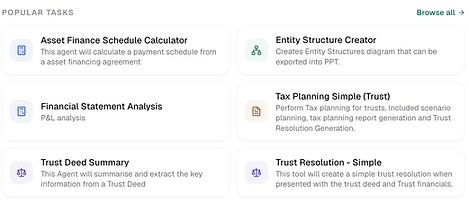
Agents that carry the workflow, not just the question.
Elfworks agents run multi-step engagements end to end — gathering facts, applying the rules, and drafting the documents — turning hours of unbillable prep into minutes, on the same validation pipeline as advice.
Trust deed summary: find the clause that matters in a 50-page deed in seconds.
Entity structuring. Upload trust deeds and information to instantly create entity structures.
FBT and tax-planning prep handled before the meeting.
DATA SECURITY
Sovereign is secure.
As AI becomes part of everyday accounting workflows, one question matters more than any other: what actually happens to your client's information when you click submit? Most AI tax platforms process data through US-based language models — data that can be compelled under the US CLOUD Act at any time, without your knowledge or your client's. The TPB has been clear: that constitutes offshore handling of client information, requiring informed client consent.
Elfworks was built differently.
Redacted before processing
STRATEGY
Sensitive client data is systematically redacted and securely re-populated. Even if data were compelled under foreign law, there is nothing identifiable to hand over.
Soveriegn AI Models
Australian-hosted models that don't store your data, don't train on it, and aren't obligated to provide it to any foreign government — all with end-to-end encryption.
Anonymised, always
Where the deepest knowledge base is needed, enterprise-grade frontier models are used, but only after client data has been anonymised.
ELFWORKS IN ACTION
See if for yourself.